/PIC_H_LOGO_1.svg "PIC dental")
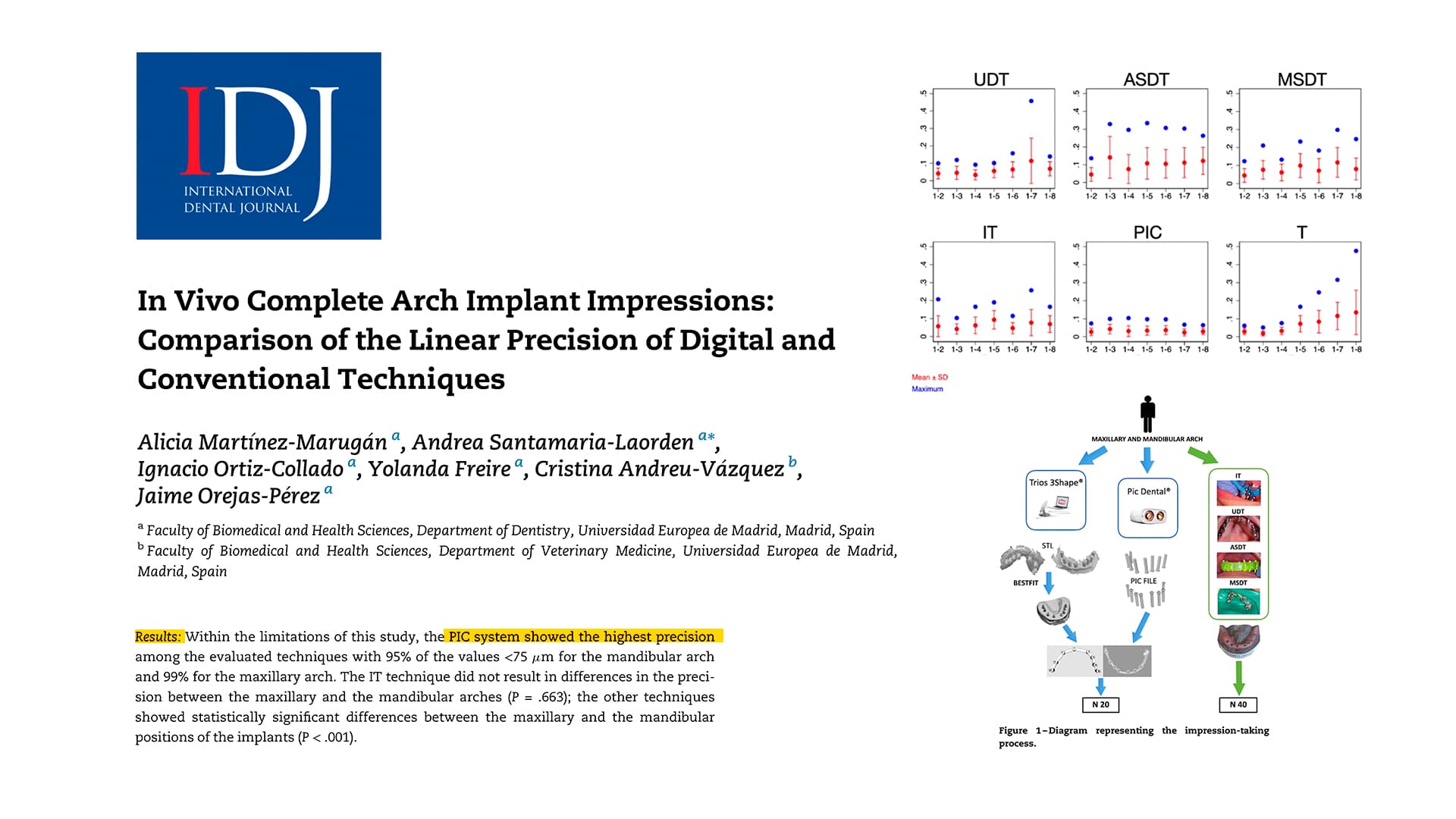
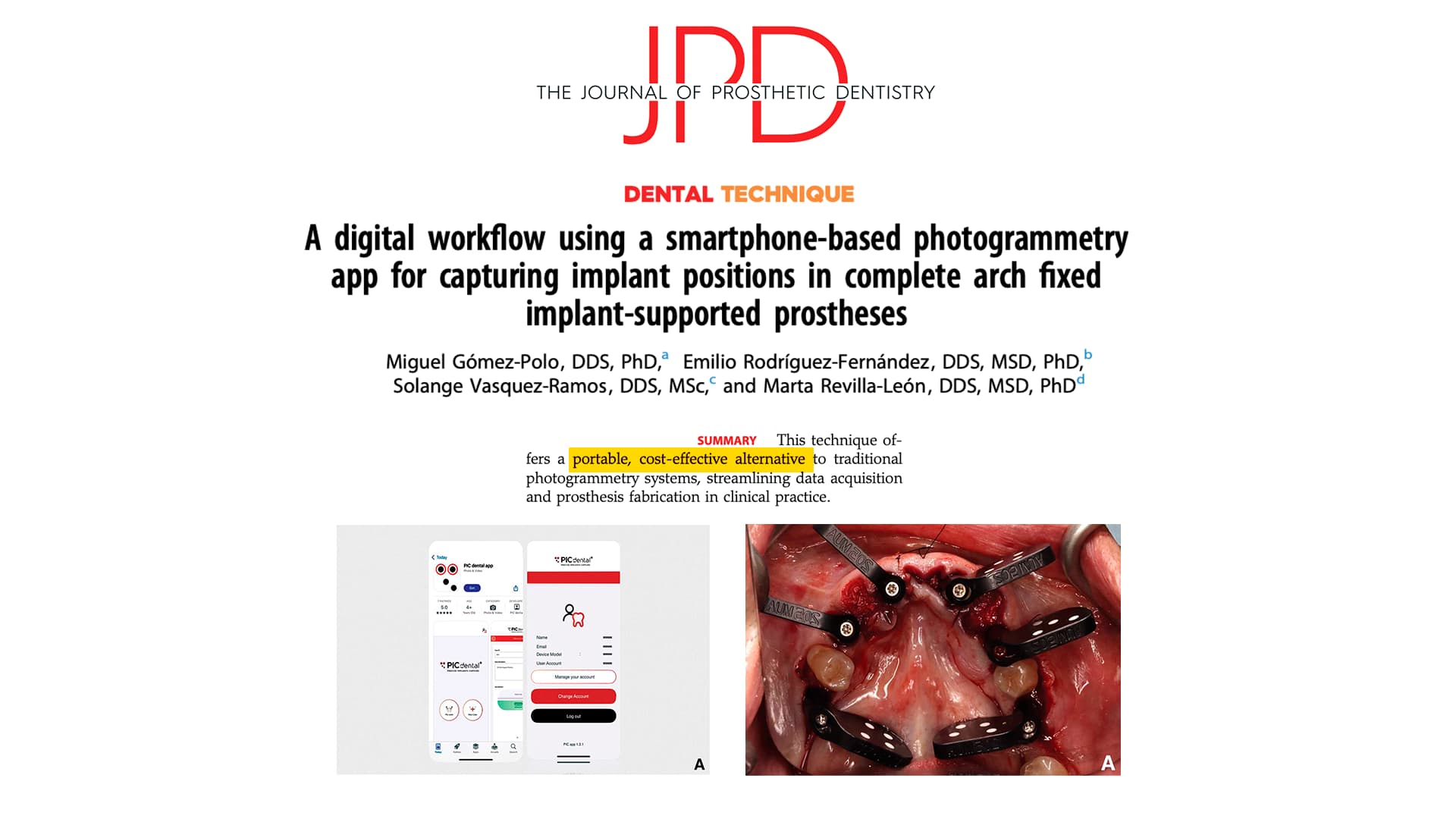
The recent study by Martínez-Marugán et al., published in the International Dental Journal in 2026, is one of a very small handful of indexed in vivo investigations evaluating digital workflows for multiple implants in the same patient.
The authors tested PIC system and intraoral scanning head-to-head against nearly every conventional technique, some of them still considered the reference standard in clinics around the world.
The patient wasn't carrying four implants. He was carrying sixteen — eight per arch — which is exactly where image-stitching algorithms, polymerization shrinkage, and operator-dependent variables start to show their limits.
Focus of the study
The researchers had three specific aims. First, to determine which of six impression techniques delivered the best in-mouth precision. Second, to evaluate whether the arch position — upper or lower jaw — influenced that precision. Third, to assess what happens when the distance between implants increases, a variable that's known to challenge optical workflows.
Six techniques were compared.
Four conventional:
-
Closed tray (IT)
-
Unsplinted direct technique (UDT)
-
Acrylic resin–splinted direct technique (ASDT)
-
CAD/CAM laser-sintered metal framework–splinted direct technique (MSDT).
Two digital:
-
Intraoral scanning with Trios (3Shape)
-
Stereophotogrammetry with PIC system
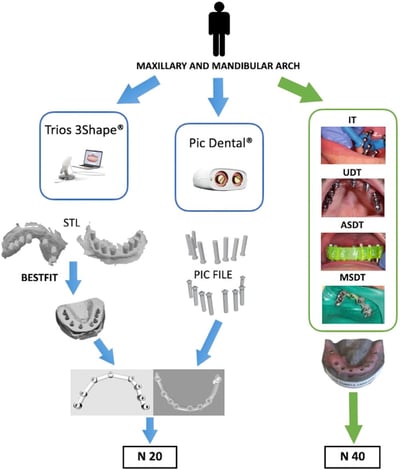
Diagram representing the impression-taking process.
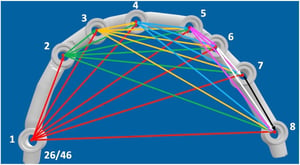 The protocol was deliberately demanding. Five impressions per technique and per arch, for a total of sixty impressions, all taken by a single experienced operator on a randomized schedule. Twenty-eight Euclidean interabutment distances were measured per impression. The conventional master casts were assessed on a high-precision coordinate measuring machine (CMM), and the digital captures were processed through the same scan body alignment and CAD sequence used in everyday lab work, which means the results reflect real workflows, not theoretical best-case scenarios.
A 75 μm threshold was used as the reference for clinically acceptable precision, in line with established literature on passive fit and implant misfit.
The results
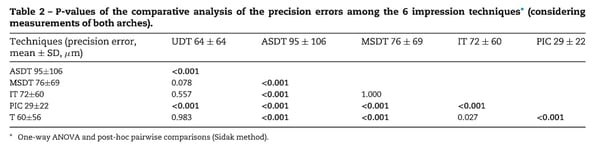
The headline result is straightforward: PIC system was the only technique whose mean precision error stayed consistently and predictably below the 75 μm threshold. Its global precision was statistically superior to all five other techniques tested, (96.8%) with p-values below 0.001 across the board.
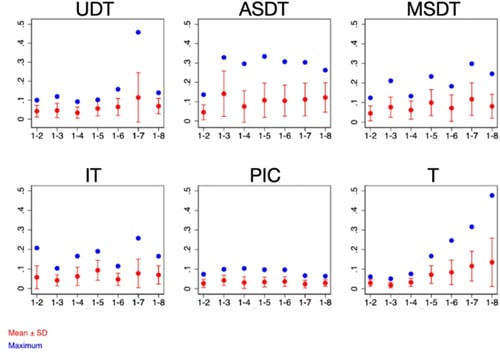
In full-arch rehabilitation, the maximum error registered by a technique matters at least as much, because a single large deviation creates the kind of shear stress that compromises long-term structural success. The maximum error figures are where the differences stop being subtle:
- PIC system: 108 μm
- IOS: 476 μm
- Acrylic resin–splinted conventional (ASDT): 658 μm
- Unsplinted conventional (UDT): 457 μm
- Metal-splinted conventional (MSDT): 389 μm
- Closed tray (IT): 310 μm
Two more findings deserve attention. First, the interimplant distance variable. The study confirms that increasing the distance between implants does not affect the precision of PIC system. With IOS, on the other hand, longer distances produced a statistically significant increase in error (p = 0.001), particularly across the full span from implant 1 to implant 8. The same pattern was observed with UDT and MSDT.
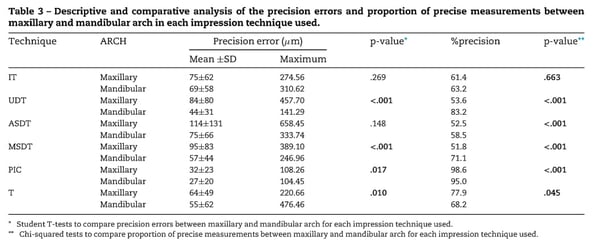
Second, the behavior by arch. PIC system delivered 98.6% of measurements within the clinical threshold in the maxilla and 95.0% in the mandible — bilateral consistency under real conditions of tongue mobility, restricted access, and posterior visibility. No other technique came close to that range in either arch.
What this means in practice
Conventional impression techniques have served the profession well for decades, and there's no need to dismiss them. But the data here makes a clear case: under in vivo conditions, on a complex case with eight implants per arch, photogrammetry is operating in a different range of precision than any of the alternatives currently considered standard.
PIC system isn't subject to the cumulative stitching error that builds up across an optical scan of a full arch. It doesn't depend on the polymerization behavior of acrylic resins, the dimensional stability of impression materials, or the operator's skill in seating a tray without distortion. It captures implant positions directly, in three-dimensional space, and the precision doesn't degrade as the case gets bigger.
For clinicians and labs working on full-arch screw-retained rehabilitations — where passive fit isn't a preference but a biomechanical requirement — the implications are significant. The literature has been pointing in this direction for a while, with multiple studies showing photogrammetry's advantages over both IOS and conventional techniques. This new in vivo evidence points to consider photogrammetry the reference standard for complete-arch implant impressions.
 For us at PIC dental, with now over 50 scientific publications since 2010, this paper matters for a reason that goes beyond the favorable numbers: it tests our technology where it has to perform, on a patient, in the kind of demanding case that defines whether a workflow is truly clinically viable or just looks good in a controlled environment.
Want to see how PIC system performs in your own workflow? Learn more about the technology, the clinical evidence behind it, and how to integrate it into your practice at picdental.com/pic-system.
SOURCE
-
Martínez-Marugán, A., Santamaria-Laorden, A., Ortiz-Collado, I., Freire, Y., Andreu-Vázquez, C., & Orejas-Pérez, J. (2026). In Vivo Complete Arch Implant Impressions: Comparison of the Linear Precision of Digital and Conventional Techniques. International Dental Journal, 76(4), 109612. https://doi.org/10.1016/j.identj.2026.109612